
A new approach to business discovery
One Business. One Specialty. One Territory.
Your Exclusive Place in the MediaIn360 Network.
We research, develop, connect, and continuously maintain a comprehensive digital discovery infrastructure for one selected business per specialty in each available territory.
One ZIP code or an entire region.
Your business. Your specialty. Your licensed territory.
Additional available territories may be licensed at discounted rates.

Illustration. Example territories and statuses only.
Your next customer could be looking anywhere
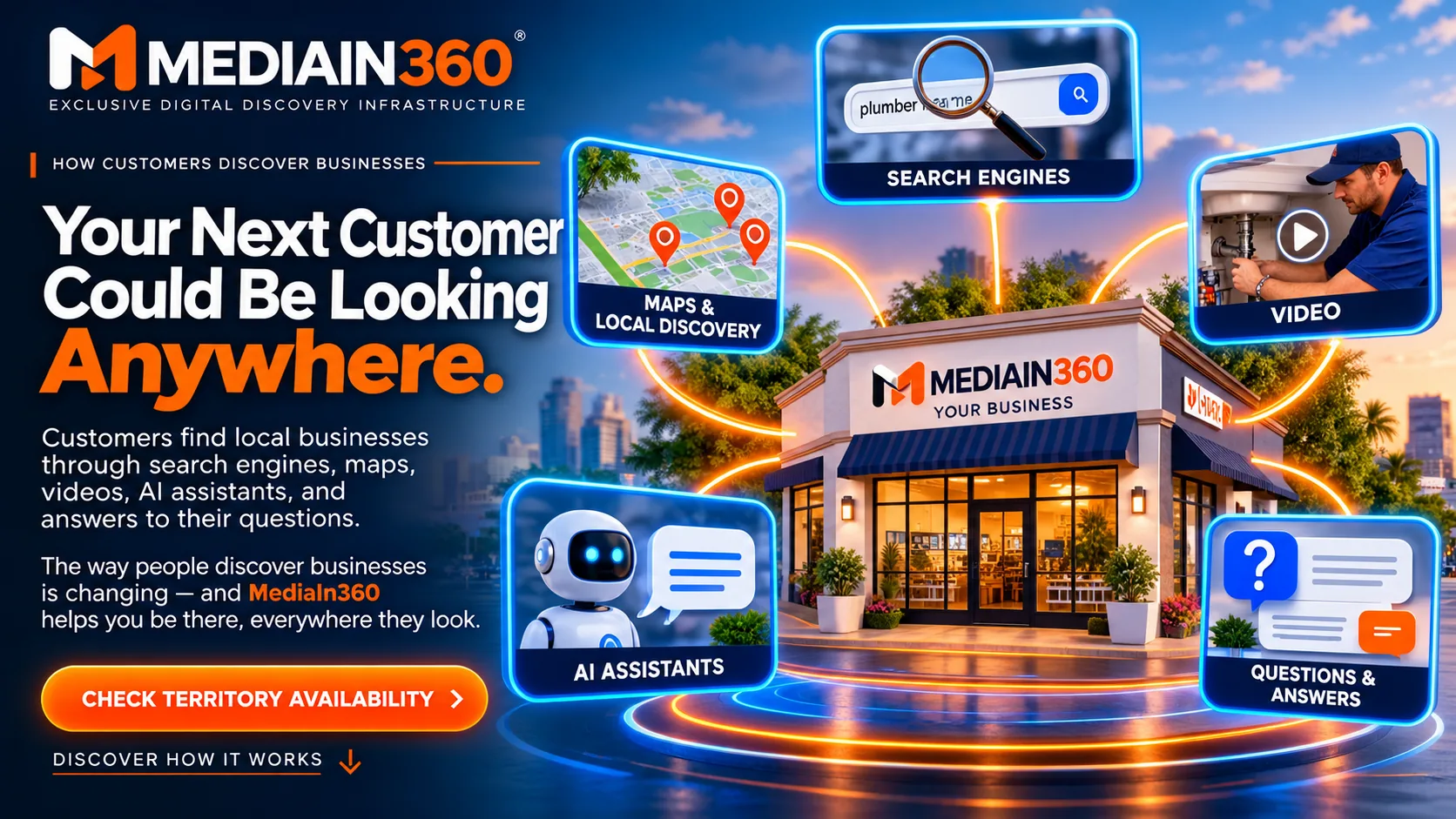
A customer needs a plumber. Another needs a roofer. Someone else needs a commercial cleaning company. They might search online, ask an AI assistant, watch a video, explore a map, or look for an answer to a specific question.
The way people discover businesses is changing, yet most businesses still depend on a handful of disconnected marketing efforts. We build the connections between the places people look and the business they're looking for.
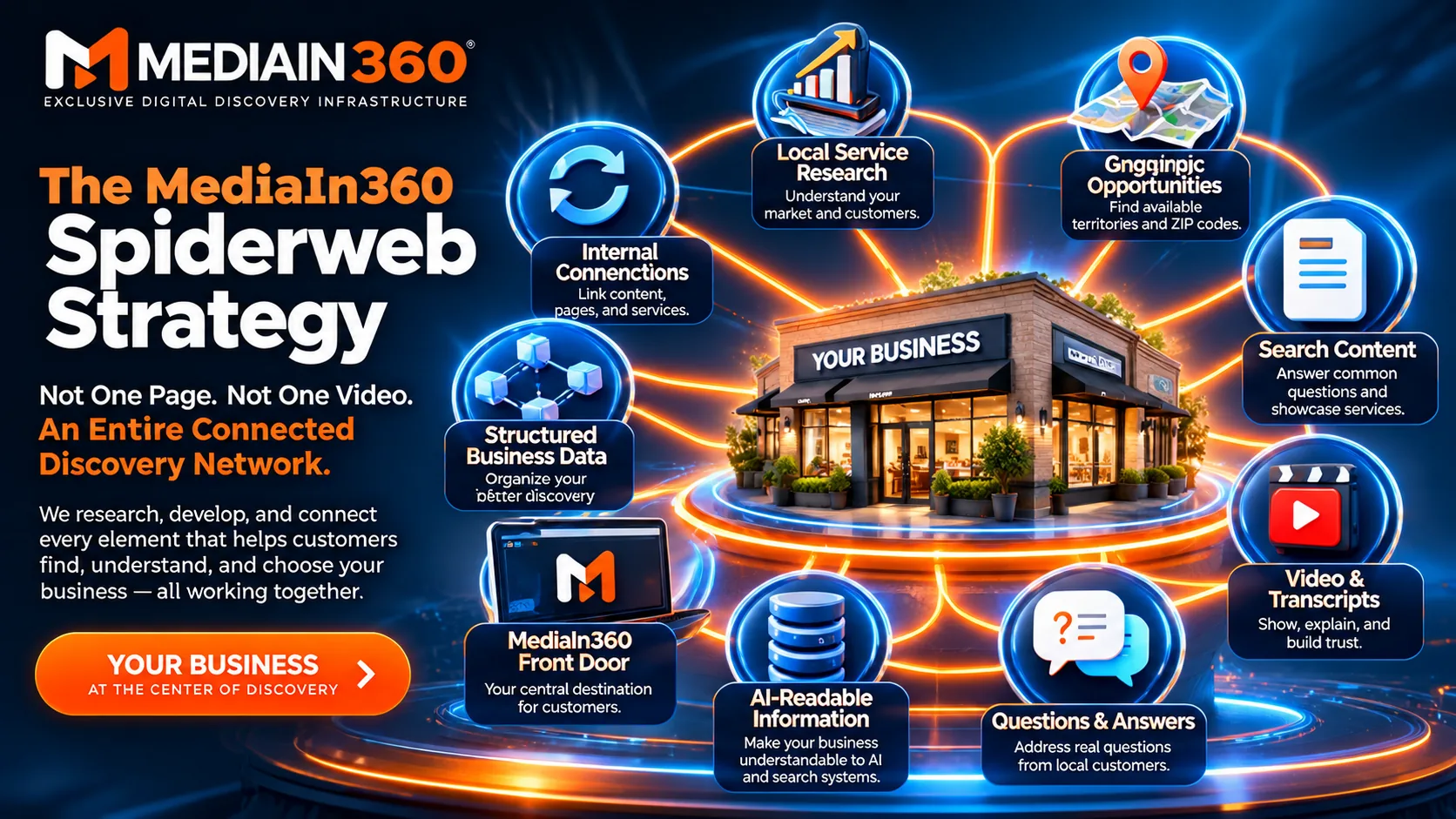
Not One Page. Not One Video. An Entire Connected Discovery Network.
We start by understanding your business, your services, your customers, and the territory you want to serve. Then we identify relevant discovery opportunities and develop the assets that support them: useful content, videos, answers, local information, technical structure, and connected pathways.
And because the way people search keeps evolving, the work doesn't stop when the initial infrastructure goes live. We keep maintaining, refining, and developing the system while your license is active.
When a territory is licensed, it's off the market.
Imagine you're a plumbing company and you license MediaIn360's plumbing representation for ZIP code 33024. While your license is active, we won't license that same plumbing territory to another plumbing company. A roofer can still license roofing there, and an electrician can still license electrical, but another plumber can't license plumbing in that ZIP.
One specialty. One ZIP code. One MediaIn360 license holder. Each ZIP code is licensed individually, and once it's taken it stays taken until the current license holder leaves the program.

An open territory
If a specialty and ZIP code is available, an eligible business can apply to license it.
Check availabilityA protected territory
Once licensed, that specialty and ZIP is no longer offered to competing businesses while the license is active. It may become available again if the license ends and the territory is released.
Join the waitlistA territory is licensed, not permanently purchased. An availability inquiry or waitlist request does not reserve a territory. Availability is confirmed only through our licensing process. Exclusivity applies to representation within MediaIn360's network; it doesn't restrict competitors' independent marketing or guarantee search rankings.
Start with one ZIP. Expand across your market.
Your business might serve one neighborhood or an entire county. Each available ZIP code is its own license, so you start with the territory that matters most and add more as they're available. Additional territories may qualify for discounted rates.
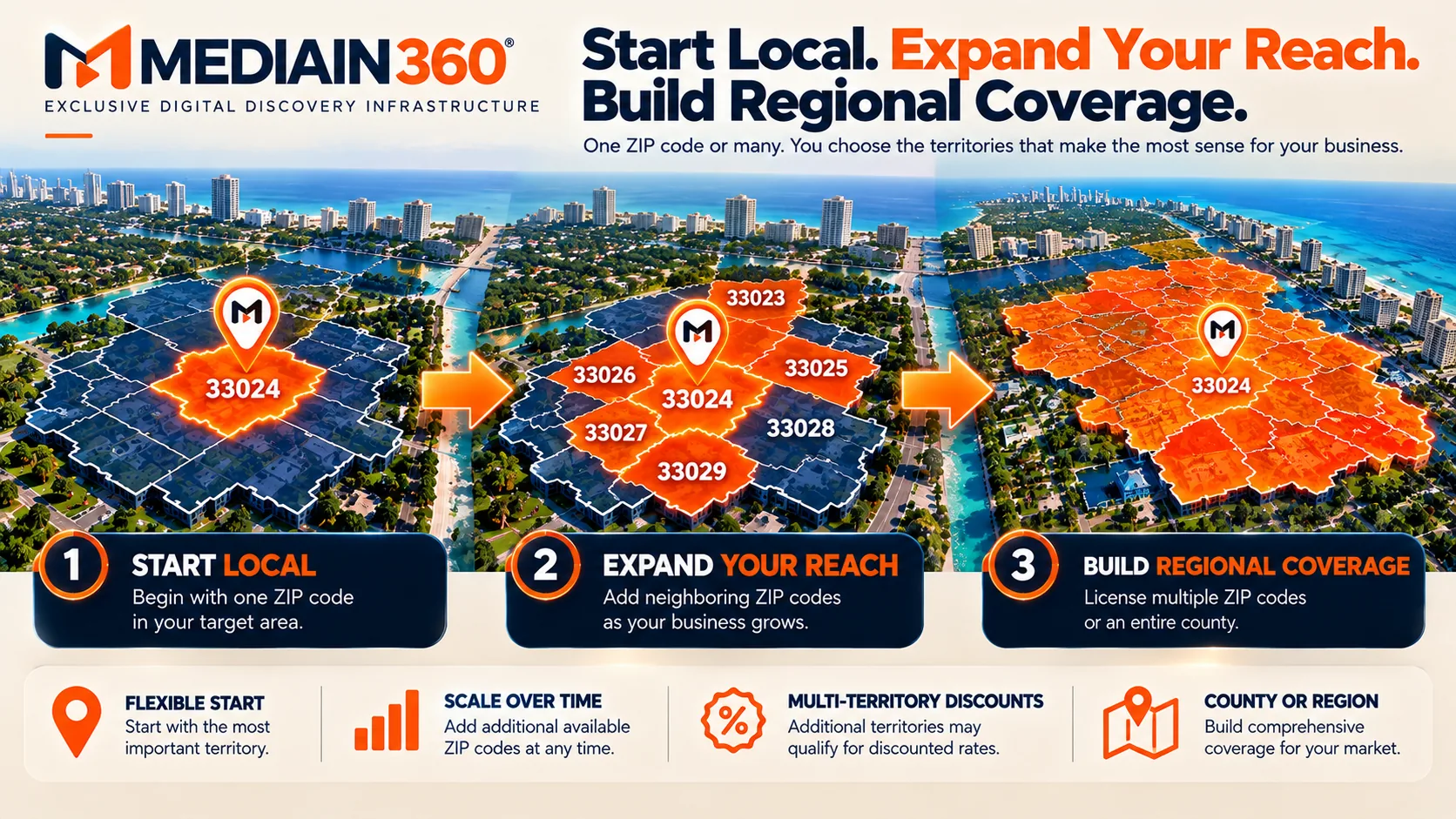
An illustration: a plumbing company wants coverage across a county with 37 ZIP codes. It licenses the ones that are available, and if a few are already held by another plumber, those stay unavailable until their holder leaves. No one receives a whole county by licensing a single ZIP code. Every territory is accounted for one at a time.
We build the infrastructure. You run your business.
Every business and territory is different, so our work is developed around the services you actually provide and the discovery opportunities relevant to your market.

1. Local research
We analyze your market, find opportunities, and build a strategy for your location.
2. Location-specific content
Original service pages, local information and FAQs for your business and area.
3. Video production
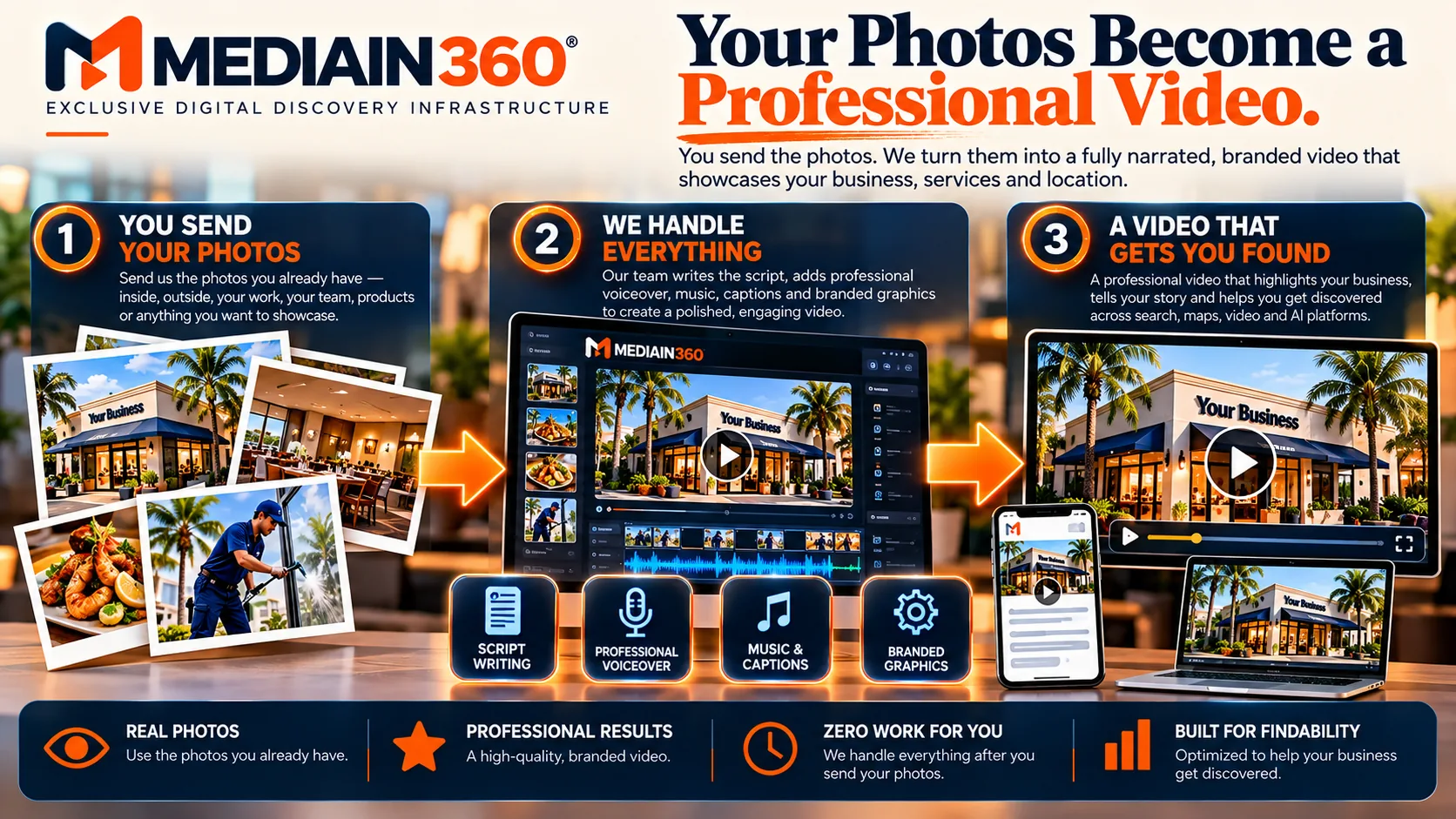
Your photos become a professional narrated video that shows your business and services.
4. Your Found First page
A landing page on MediaIn360 that brings your video, offers, answers and location content together.
5. Digital structure and distribution
We connect your content across multiple digital assets so everything works together.
6. Ongoing development
We maintain, refine and expand your assets over time as search technology changes.
Tools that help you run it yourself
Know if it’s working
A simple ROI tracker, a tracking phone number, and tagged links and QR codes, so you can see which source your calls and visits came from.
Keep your listings straight
A guide to claiming and fixing your Google Business Profile and your name, address, and phone across the web, so you don’t need to pay anyone to do it.
Change your offer yourself
Update your offer whenever you like. If something works, keep it. If it doesn’t, change it. QR codes can point customers to reports and to your Google review page.
34 masters. 40 criteria. 6 stages. Zero guessing.
Every criterion in the CORXIT Standard traces to published, citable research — 25 peer-reviewed researchers and 9 field-tested masters — not opinion, not trend, not taste. Tap any name to see their contribution and exactly where it's applied.
Every criterion sits in one of six stages.
Every mechanism below is real, published, peer-reviewed science — that part is settled. What's never been tested at scale is whether building to it, instead of guessing on colors and feelings, actually converts better. Nobody's published that data yet. We're finding out, live, and we'll adjust our own standard as real results come in.
Open the full research roster
25 researchers. Tap any name.
Daniel Kahneman
APPLIED TO: Perception · Stage 01
Kahneman's Nobel-winning research established that human thinking runs on two systems: System One is fast, automatic, and unconscious; System Two is slow and deliberate. Most decisions, including whether to engage with a business, are made by System One before System Two ever gets involved. With longtime collaborator Amos Tversky, Kahneman's work on Prospect Theory also showed people feel the pain of a loss roughly twice as intensely as the pleasure of an equivalent gain — the foundation of loss aversion.
Robert Cialdini
APPLIED TO: Trust · Stage 02
Cialdini's six principles of influence — reciprocity, commitment, social proof, authority, liking, and scarcity — document the specific mechanisms that cause people to say yes. Trust signals have to appear before commitment is requested, not after.
BJ Fogg
APPLIED TO: Decision · Stage 03
Fogg's Behavior Model states that an action only happens when motivation, ability, and a trigger converge at the same moment. Remove any one, and the action doesn't happen, no matter how strong the others are.
Jakob Nielsen
APPLIED TO: Perception & Trust · Stages 01-02
Nielsen's research established that people form their expectations from how most websites work, and that breaking those conventions increases mental effort. His reading-pattern research documents exactly where on a page people actually look first.
George Miller
APPLIED TO: Perception & Decision · Stages 01 & 03
Miller's famous 1956 finding established that working memory reliably holds only around seven items before things start getting dropped. Past that point, decisions get deferred and people disengage.
Sheena Iyengar
APPLIED TO: Decision · Stage 03
Iyengar's well-known research on choice overload showed that how options are sequenced and grouped — not just how many exist — determines whether anyone chooses at all.
Richard Thaler
APPLIED TO: Trust · Stage 02
Thaler's work on nudges and mental accounting showed that small, well-placed changes in how a choice is presented — defaults, framing, structure — can significantly shift behavior without restricting any option.
Albert Mehrabian
APPLIED TO: Presentation · Stage 04
Mehrabian's communication-consistency research established that when what's said and how it looks conflict, how it looks wins. Strong claims on a visually inconsistent page get quietly discounted by that inconsistency.
Gerd Gigerenzer
APPLIED TO: Decision · Stage 03
Gigerenzer's research on fast and frugal heuristics shows people rely on simple mental shortcuts to make good-enough decisions quickly, especially under uncertainty.
Paul Ekman
APPLIED TO: Presentation · Stage 04
Ekman's research on micro-expressions showed people detect inconsistency between what's said and how it's shown almost instantly, and subconsciously.
Alan Cooper
APPLIED TO: Presentation · Stage 04
Cooper's goal-directed design principle holds that good design starts from what the visitor is trying to accomplish, not from what the business wants to show off.
John Sweller
APPLIED TO: Perception · Stage 01
Sweller's Cognitive Load Theory shows comprehension breaks down once mental effort exceeds working memory capacity — even when every individual piece of information is accurate.
Robert Bjork
APPLIED TO: Perception · Stage 01
Bjork's research on desirable difficulties shows some effort aids memory — but effort spent decoding a confusing layout only causes people to give up, not to remember more.
Donald Norman
APPLIED TO: Presentation · Stage 04
Norman established the idea of affordances and signifiers — that things should make their correct use obvious through design alone. When a page deviates from expected patterns, it creates friction that erodes trust before a customer can say why.
Susan Weinschenk
APPLIED TO: Decision · Stage 03
Weinschenk's applied research translates lab-level behavioral findings into consistent, measurable patterns in how real people act online.
Itamar Simonson
APPLIED TO: Trust & Decision · Stages 02-03
Simonson's research on context-dependent choice, including the compromise effect, shows people rarely judge an option alone — they judge it against whatever else is presented next to it.
Gitte Lindgaard
APPLIED TO: Perception · Stage 01
Lindgaard's Carleton University research found that people form a lasting visual-appeal judgment about a website in as little as 50 milliseconds — long before they've read a single word.
Antonio Damasio
APPLIED TO: Perception · Stage 01
Damasio's Somatic Marker Hypothesis found that emotion isn't separate from decision-making — it's the mechanism that makes fast decisions possible at all. People with damage to emotional processing become worse decision-makers, not more rational ones.
Leon Festinger
APPLIED TO: Decision · Stage 03
Festinger's theory of cognitive dissonance showed people are uncomfortable holding two conflicting thoughts at once — and will act to resolve that discomfort faster than they'll act on a neutral statement they can simply file away.
Dan Ariely
APPLIED TO: Trust · Stage 02
Ariely's research on pricing psychology, including the decoy effect, showed people rarely evaluate a price in isolation — they evaluate it against whatever comparison point is placed near it, predictably and consistently.
Amos Tversky
APPLIED TO: Perception · Stage 01
Tversky co-developed Prospect Theory and the heuristics-and-biases research program with Daniel Kahneman, publishing the original framing and loss-aversion studies together in peer-reviewed journals including Econometrica and Science. Much of what carries Kahneman's name alone in popular use was originally joint, peer-reviewed work.
Cass Sunstein
APPLIED TO: Decision · Stage 03
Sunstein's peer-reviewed research on choice architecture (with Richard Thaler) documents how the way options are structured and defaulted — not just what they are — measurably changes what people choose, independent of persuasion or content.
Paul Slovic
APPLIED TO: Trust · Stage 02
Slovic's peer-reviewed work on the affect heuristic established that people frequently judge risk and value using a fast emotional reaction — "how does this feel" — as a substitute for slower, deliberate analysis.
Shafir & Mullainathan
APPLIED TO: Decision · Stage 03
Eldar Shafir and Sendhil Mullainathan's peer-reviewed research on scarcity showed that feeling short on time or money measurably narrows attention and changes decision-making — a visitor under real or perceived pressure processes information differently than one who isn't.
Herbert Simon
APPLIED TO: Decision · Stage 03
Simon's Nobel-winning concept of bounded rationality established that people don't exhaustively evaluate every option — they satisfice, picking the first option that clears a "good enough" bar, especially under time or information constraints.
These 9 aren't peer-reviewed researchers — they're the practitioners whose frameworks CORXIT builds from. Field-tested for decades, still holding up today.
8 masters. Tap any name.
Eugene Schwartz
APPLIED TO: Perception · Stage 01
Schwartz's 1966 theory of market sophistication holds that every market moves through stages of awareness — a message that lands in one stage falls flat in another.
Al Ries
APPLIED TO: Perception · Stage 01
Ries's 1981 positioning theory holds that a business doesn't win by being better — it wins by owning a single distinct word or idea in the customer's mind before a competitor claims it.
Jack Trout
APPLIED TO: Perception · Stage 01
Trout's research alongside Ries established that the mind rejects complexity and defaults to the simplest available distinction between options — the business that gets there first, in the fewest words, tends to win the position.
David Ogilvy
APPLIED TO: Trust · Stage 02
Ogilvy argued that advertising's job is to sell, not to entertain, and that clarity and honest claims consistently outperform cleverness — a discipline he insisted on decades before it was measurable at scale.
Claude Hopkins
APPLIED TO: Trust · Stage 02
Hopkins's 1923 book was among the first to argue advertising should be tested and measured like an experiment, not judged on taste — every claim should be traceable to a reason, not an opinion.
Al Ramadan
APPLIED TO: Presentation · Stage 04
Ramadan's research on category-creating companies found they grow faster and more durably than category competitors, because they set the terms of comparison instead of accepting someone else's.
Dave Peterson
APPLIED TO: Presentation · Stage 04
Peterson's work alongside Ramadan and Lochhead documented that category creation is a repeatable discipline, not a lucky accident — a specific, learnable sequence rather than a matter of timing.
Christopher Lochhead
APPLIED TO: Presentation · Stage 04
Lochhead's writing on category design argues that most businesses lose by default the moment they accept an existing category's rules, rather than defining their own.
Barry Schwartz
APPLIED TO: Decision · Stage 03
Schwartz's peer-reviewed research on maximizing versus satisficing found that people who exhaustively compare every option before deciding end up less satisfied than those who pick the first option that clears a "good enough" bar — distinct from, and building on, the choice-overload research already credited to Sheena Iyengar above.
Same materials. Same evaluator. Same score. Every time.
Every criterion produces a binary yes or no based on a directly observable condition. No inference, no assumption, no benefit of the doubt. That's what makes CORXIT's score trustworthy — the criterion decides, not the evaluator.
Built to the CORXIT Standard. Read it on corxit.com →
Don't just read about it. See what we build.
A connected discovery system is easier to understand when you can see the pieces. Above Eye Level Cleaning and Cocoa Beach Today are both ours, which is why we can show them openly. Cocoa Beach Today is a working prototype of what a whole town looks like: a visitor guide with 700+ local businesses, built to a standard we can repeat. We don't have customer testimonials to show yet, and we'd rather show you real work than invented praise.

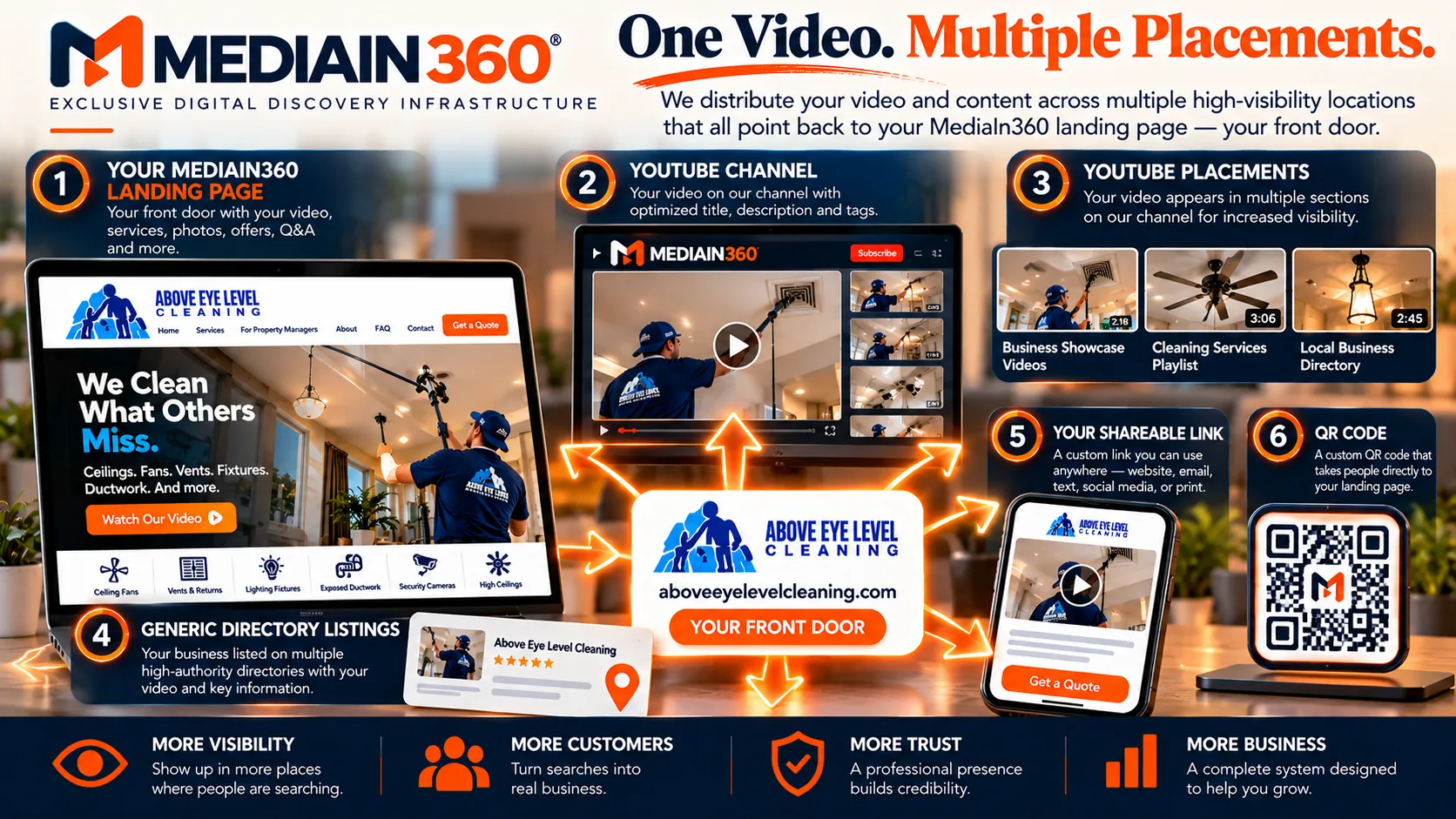
More views of the same example

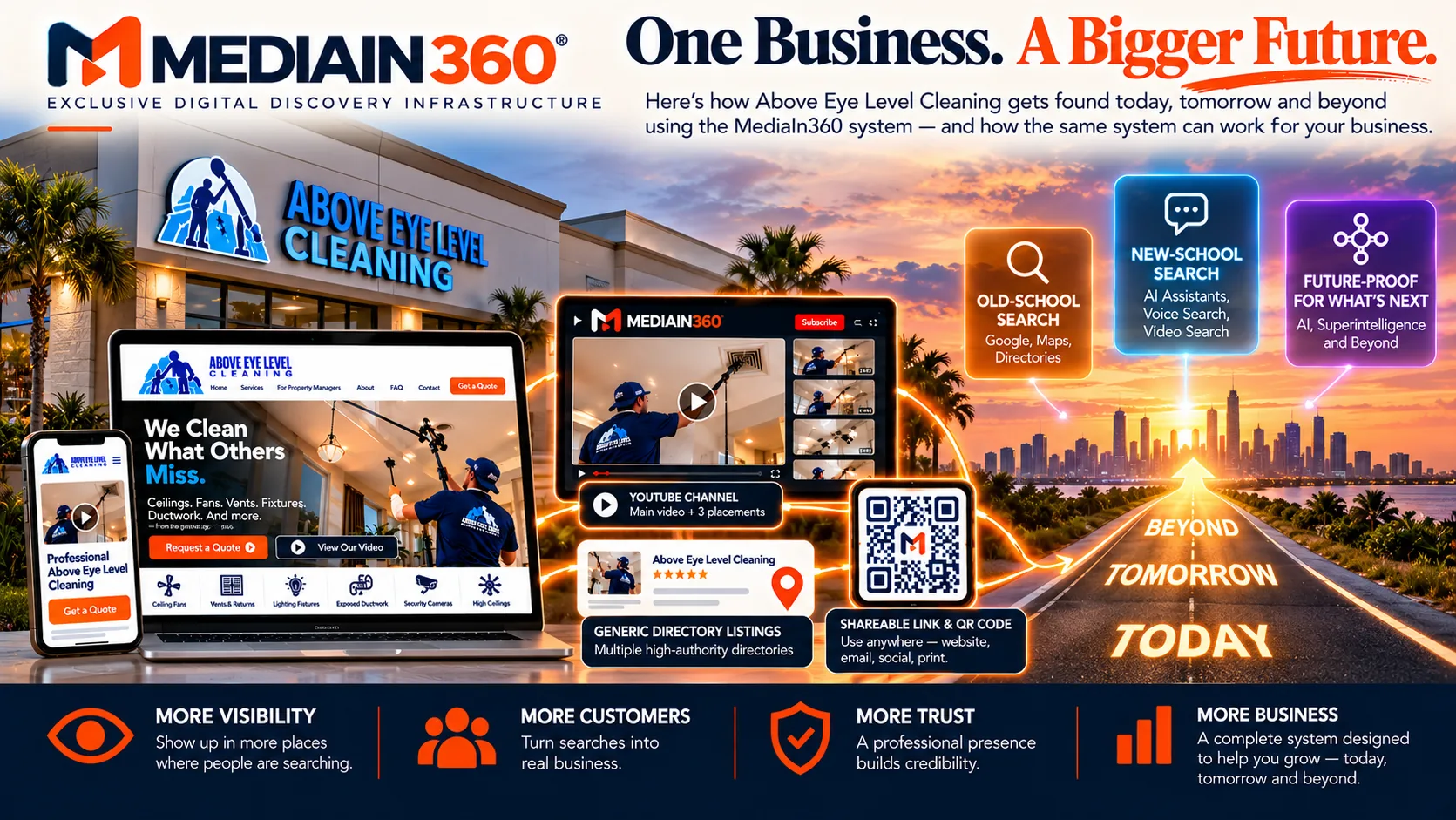
These are illustrations. Territory examples, availability statuses and results shown in the graphics are for demonstration only. They are not live availability data, a completed premium territory deployment, or measured outcomes, and they are not a promise of any result.
What is a Found First page?
Your business is yours. The infrastructure is ours.
Stays yours
- Your business name and customers
- Your reputation and your reviews
- Your own Google Business Profile
- Your own website
- Your logo and photos (we use them to build your pages while you’re a customer)
Stays with MediaIn360
- The territory position and the network
- Our research, templates, and standard
- The domains and the pages we host
- The foundation we build in your territory
You’re licensing access to the agreed MediaIn360 representation and ongoing services, not buying our underlying technology. There’s no long-term contract and you can leave at any time. If you do, your business-specific content comes down and the territory can be offered to another business in your specialty, who starts from our foundation but earns their own reviews and reputation. Your specific rights, and what happens when a license ends, are explained in a written agreement you’ll see before you decide.
From an available territory to active discovery infrastructure.
- Tell us about your businessYour business, primary specialty, and the ZIP codes you want to serve.
- We verify availabilityWe check whether your specialty is available in each ZIP code you requested.
- Review your private proposalWe explain the scope, available territories, the initial investment, the ongoing license, and the terms, in writing, before you commit.
- We research, build, and launchOnce approved, we develop the agreed infrastructure around your business and licensed territories.
- We maintain and develop itYour active license supports continued maintenance and development, with a monthly report on what was done.
Ambitious strategy. Honest limits.
What we commit to
- A defined specialty and territory license
- A written development scope
- The agreed research, infrastructure development, and maintenance
- Exclusivity within MediaIn360's network for each active licensed specialty and ZIP code
- Clear reporting on the work performed and the measurable activity available
What no one can guarantee
- A position in Google or other search results
- Recommendations from AI assistants
- A specific number of leads or customers
- Revenue or return on investment
- Control over competitors' independent marketing
Results take time. Early on you'll see pages going live, being indexed, and listings being corrected; calls and leads usually take months to show, and some businesses may see little change. We use tracking numbers, tagged links, search and map data, and what customers tell you, and we'll tell you where the picture is incomplete. We control the quality and execution of our work, not the decisions of search engines or customers.
A few things worth knowing.
What is the Exclusive Territory Network?
Is my territory really exclusive?
Can I license more than one ZIP code?
Can I license an entire county?
What if someone already has my ZIP code?
Do I own the ZIP code?
What happens if I stop paying or leave?
Does this replace my existing website?
Will I receive guaranteed leads?
How will I know if it's working?
What do I need to do?
How much does it cost?
Is this scientifically proven?
Is your specialty still available in the territory you want?
Tell us what your business does and where you want MediaIn360 representation. We'll review your requested specialty and territories, confirm availability through our licensing process, and explain your options.
Check Territory Availability ›No obligation to purchase. Territory availability is not guaranteed until formally confirmed and reserved.
Found First, or Exclusive Territory Network?
Found First is open to everyone. The Exclusive Territory Network is one business per specialty per ZIP.
| Found First | Exclusive Territory Network | |
|---|---|---|
| Price | $199 once, then $24.97/mo | Custom quote |
| Photos turned into a narrated video | ✓ | ✓ |
| Custom, search-optimized Found First page | ✓ | ✓ |
| AI-readable questions and answers | ✓ | ✓ |
| Shareable link and branded QR code | ✓ | ✓ |
| PDF guides, including QR strategy | ✓ | ✓ |
| GBP/NAP and Revenue Reality tools | ✓ | ✓ |
| Standard video placements and directory listing | ✓ | ✓ |
| Essential factual corrections | ✓ | ✓ |
| Match report on your current website | ✓ | ✓ |
| Back-end findability correction of your current site | Quoted after audit | ✓ |
| A standing offer written into your page | ✓ | ✓ |
| Customer dashboard | — | ✓ |
| Live offer and coupon changes | — | ✓ |
| FindIt, the hidden-character game | — | ✓ |
| Performance reporting | — | ✓ |
| Ongoing research and improvements | — | ✓ |
| Expanded Spiderweb network | — | ✓ |
| Exclusive specialty and ZIP code | — | ✓ |
| Hands-on account management | — | ✓ |
The Exclusive Territory Network is priced to your area and category, and to the research and customization your territory needs. Exclusivity applies only within MediaIn360’s own network. Results are not guaranteed. See Found First pricing.
Why they matter.
Found First gets people to your page. The Exclusive Territory Network gives them a reason to act once they are there, and shows you what happened.
Live offers and coupons
Write an offer and change it yourself, live, whenever your business needs a new reason to call, book or walk in. Your link and QR code never change.
A dashboard that shows what is working
See how many people found you, showed interest and redeemed, so you are looking at real numbers and not a guess.
FindIt, the hidden-character game
A small character, Finley, hides on your page. Visitors who find him unlock the reward you chose. The surprise gives people a reason to look, stay and act. Meet FindIt
People tend to engage more with a small reward they have to look for than with a plain “click here.” FindIt is built on that idea, and everything runs from your page, not from inside the video. The video simply points viewers to it. Results vary, and nothing here is a guarantee.
Let's see what's available.
Keep it short. We only need enough to check your specialty and territories.
Your territory request is ready to send.
Your email app should have opened with your details filled in. Press send there and we'll review your requested specialty and territories and contact you about availability and next steps. Submitting a request doesn't reserve or guarantee a territory.
If nothing opened, email info@mediain360.com or call or text (954) 367-9274.